The Sigma AI Ecosystem
High-Performance Native Infrastructure for Developer Agents
Steven Varga • Varga Labs
Process Containment • Agent Fleet • Editor Bridges • Multi-Provider Routing
Use → to navigate the top-level narrative, or ↓ to drill down into technical details.
What is an AI Agent?
Beyond the Chatbox: The Autonomous Perception-Action Loop
The Passive Chatbot
Single-turn conversational model:
- Stateless Query-Response: User sends text prompt; model generates text response and stops.
- Isolated from Reality: Cannot inspect compiler errors, examine file contents, or run tests.
- Zero Action: Cannot mutate code or fix regressions; human must copy-paste solutions.
The Autonomous Agent
Active software actor in an execution environment:
- Perceive: Reads workspace trees, ASTs, build logs, and git diffs.
- Reason: Synthesizes multi-step plans and evaluates candidate edits.
- Act: Executes tools (file edits, compiler runs, test suites).
- Observe: Evaluates tool results, adapts to errors, loops until verified.
Core Principle: An agent is not a text generator. It is an untrusted software process executing code mutations inside your workspace.
The Autonomous Execution Loop: "The Ping-Pong Game"
An autonomous developer agent is not a single prompt. It is a continuous rally between Reasoner and Environment.
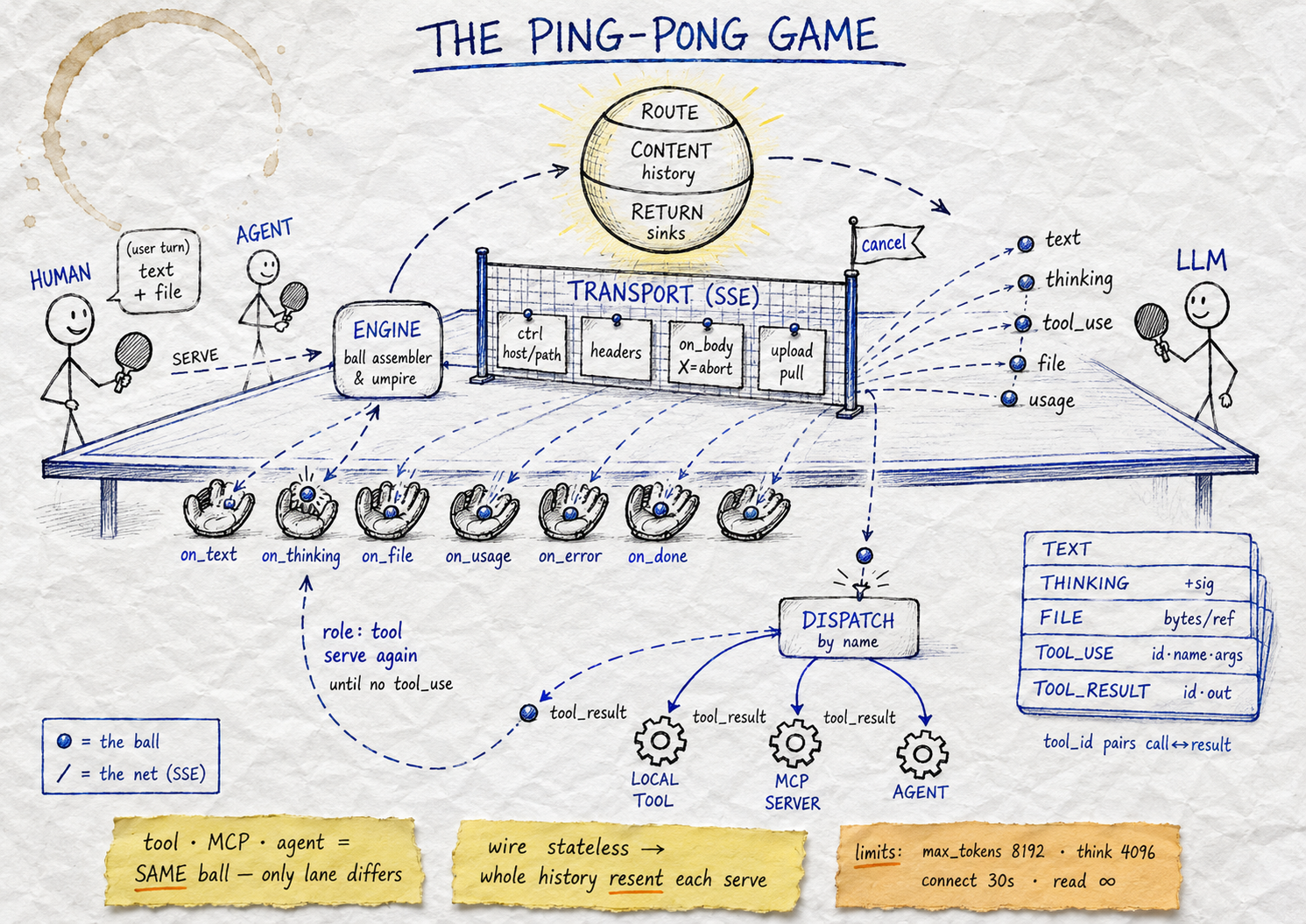
The Rally Dynamic
Player 1 (The Model): Emits intent and candidate code modifications.
Player 2 (The Workspace): Compiles, lints, and returns test observations.
The rally repeats until tests pass and acceptance criteria are satisfied.
Architecture Invariants
- Dynamic Token Budgets: Context limits budgeted per model turn.
- Typed UDS Framing: Big-endian binary frames over Unix Domain Sockets.
- Multi-Lane Bus: Providers, Tools, Memory, and Tape coordinated via Router.
- 4 Tool Branches: Local subprocesses, MCP, client exec, and agent child.
The Ping-Pong Ball: The LLM Context Window
What actually flies across the net? The context window is the physical carrier of state in the agent rally.
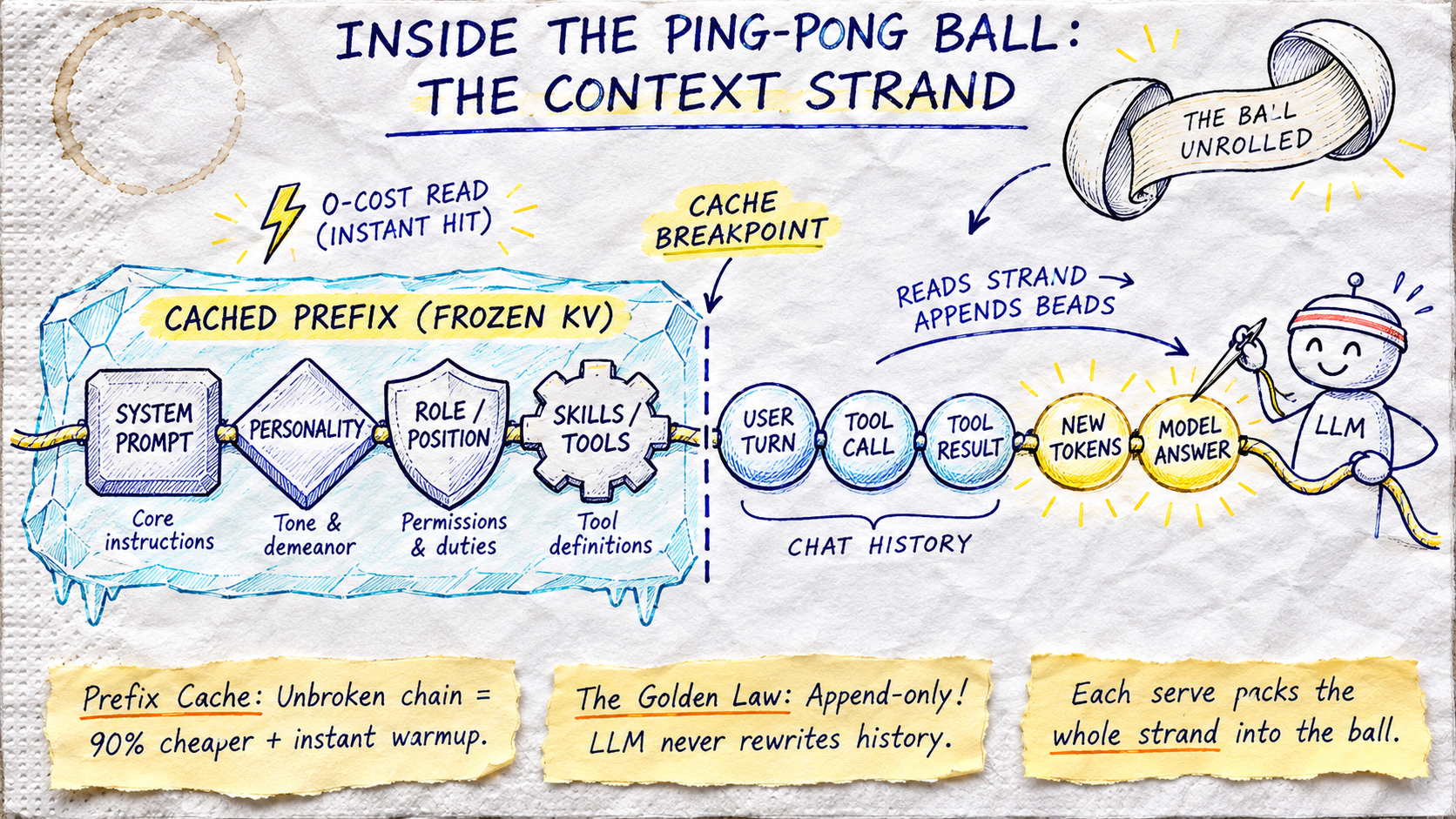
The Physics of the Context Ball
Every stroke of the paddle imprints information onto the ball:
- Paddle A (Model Stroke): Inscribes reasoning tokens, chain of thought, and structured tool requests.
- The Net (Bus & Invariants): Validates bounds, token budgets, and permissions.
- Paddle B (Environment Stroke): Inscribes compiler logs, file diffs, and test assertions.
Accumulating Mass & Deformation
As the rally lengthens, the ball accumulates weight. If unmanaged, context limits burst, cache eviction penalties spike, and the ball drops (silent truncation & hallucination).
How Sigma Manages the Ball
Strict admission token limits, deterministic memory atomization, tape ledger compaction, and attempt fencing keep the rally moving without dropping state.
Context & Prompt Engineering: Shaping the Ball
Moving from single-turn "clever phrasing" to deterministic multi-turn systems state management.
The Engineering Shift
| Dimension | Naive Prompting | Context Engineering |
|---|---|---|
| Scope | Single-turn string format | Multi-turn state machine |
| Structure | Markdown prose walls | Strict schemas & typed tags |
| Evidence | Latent weight guessing | Verified reads & compiler codes |
| Lifecycle | Transient, discarded | Compacted, epoch-keyed, cached |
1. Cache-Friendly Prefix Architecture
Static rules (AGENTS.md, tool schemas) sit at the head; dynamic memories and observations append at the tail → ~80% KV-cache hits, slashing latency and cost.
2. Evidence-Based Grounding
No hallucinated file edits. File mutations require a current read_file in the active context window. Observations are raw exit codes and diffs, not narrative opinions.
3. Deterministic Compaction Epochs
When the ball exceeds headroom limits, older turns fold into 12 KiB semantic summaries. Verbose compiler logs collapse to exit codes with fetch tokens (tool_result_read).
The Core Invariant: Prompt engineering guides the model's intent. Context engineering determines whether that intent survives turn twelve without attention degradation or state loss.
What is a Token? Tokenization Mechanics & SOTA Variance
LLMs do not read characters or words—they perceive integer token IDs via Byte-Pair Encoding (BPE).
1. The Atomic Unit of Perception
Text is translated into numbers via a fixed statistical vocabulary before neural processing:
- Subword Chunking: Common words/keywords (
return,void,std::) are 1 token. Rare or complex names (snake_case_t) fragment into 3–4 subwords. - Whitespace & Indentation: Leading vs trailing spaces, tabs vs 4-space runs change token boundaries. A single trailing space can alter the token ID.
- Rule of Thumb: In English text: ~1 token ≈ 0.75 words (≈ 4 chars). In C++ & structured JSON: fragmentation spikes token consumption by 30–50%.
"sigma", "_", "aid"] (3 tokens in legacy BPE)"void test()" → [
"void", " test", "()"] (3 tokens)
2. SOTA Variance Across Frontiers
Vocabulary size dictates code compression ratio and effective context capacity:
| Generation / Model | Vocab Size | Code Compression & Behavior |
|---|---|---|
| Legacy (GPT-3 / LLaMA 1) | ~32k–50k | Heavy fragmentation; high token tax on code & JSON. |
| OpenAI cl100k → o200k | 100k → 200k | o200k (GPT-4o) yields 15–20% denser code compression. |
| Claude 3.5 / 3.7 | ~65k–100k | Optimized for XML tool wrapping, indentation & prose. |
| Qwen 2.5 / LLaMA 3 | 128k–152k | Single tokens for multi-space indents & polyglot code. |
The Engineering Takeaway: A larger vocabulary means the exact same 500-line C++ file consumes ~25% fewer tokens—effectively expanding your context budget.
The Metric of Truth: Context limits, admission budgets, KV-cache slots, and cloud invoices are measured in tokens, never lines of code. How these tokens accumulate across turns dictates whether your agent succeeds or burns out.
The Physics of Context Growth: Cost Explosion & Attention Rot
Why naive "infinite context windows" are an operational trap: quadratic billing taxes and cognitive degradation.
1. The Cumulative Cost Explosion
In an agent rally, each new turn re-sends the entire accumulated transcript. The billing math is super-linear:
- The 15-Turn Reality: A task starting with 5k tokens accumulating 4k tokens of logs per turn consumes ~540,000 billed tokens.
- Without Prefix Caching: A $0.03 task balloons to $3.50+ on a single debugging rally.
- Latency Spike: Time-to-first-token (TTFT) climbs from 300ms to 4+ seconds as the context swells.
2. Attention Rot & "Lost in the Middle"
Research (Liu et al., Anthropic) proves that LLM retrieval accuracy collapses when critical constraints sink into the middle of deep context:
- Attention Saturation: As 20,000 lines of raw compiler output flood context, soft-max attention weights dilute across noise.
- Circular Regressions: The model forgets constraints stated in turn 1 and reverts working fixes implemented in turn 3.
- Hallucinated Victory: Cognitive overload triggers sycophancy: claiming "All tests pass!" while quietly deleting failing assertions.
The Systems Mandate: A 200k context window gives the model room to get lost. Without early admission limits (85% cap), tool budgeting (64 KiB), and semantic compaction epochs, longer sessions produce worse code at higher cost.
The Systems Architecture: Inside the Engine
Ground truth multi-lane message bus architecture (sigma::aid::bus_t) choreographing the rally.
Sockets enter the central message bus. Lanes never communicate directly; all events fan out through the router.
Model emits tool calls → Router dispatches to 4 branches → Results joined to Router → Continuation back to Model.
Immutable disk ledger persists routed events without blocking or entering the return execution path.
What Can AI Systems Actually Solve?
Empirical Reality: 84% Developer Adoption vs. 6.6% Unconditional Trust
The High Adoption & Tactical Wins
Stack Overflow 2025/2026 Developer Survey:
- 84% Adoption: Vast majority of engineers actively use or plan to adopt AI tooling; 51% use it daily.
- 74% Implementation: Proven speedups writing boilerplate, API plumbing, and glue code.
- 66% Diagnostics: Rapid decoding of complex compiler errors, SQL queries, and unfamiliar codebases.
The Trust & Complexity Cliff
Scale AI SWE-bench Pro, METR, GitClear:
- Only 6.6% Trust: Developers overwhelmingly distrust unverified AI output for non-trivial decisions.
- 23% Success on Real Repos: Frontier models drop from 70%+ on synthetic tests to 23% on real codebases (SWE-bench Pro).
- Degraded Stability: Unconstrained AI correlates with -7.2% delivery stability and massive code duplication.
The Verification Mandate: Developers reject AI as an unconstrained “oracle.” They embrace AI when it operates as an untrusted junior engineer inside a deterministic compiler and test verification harness.
The Empirical Sweet Spot: Where AI Delivers Real Value
Verified developer productivity gains from Stack Overflow, GitHub, and enterprise field studies.
Localized Code Implementation
74% UsefulGenerating boilerplate, data conversion routines, serialization formats, API glue, and client bindings. Replaces repetitive manual typing with fast reviewable drafts.
Diagnostics & Explanations
66% UsefulTranslating 40-line template metaprogramming errors into plain English, navigating unfamiliar libraries, explaining legacy logic, and constructing regex/SQL queries.
Test Generation & Edge Cases
High ROISynthesizing unit tests, mocking external interfaces, generating property fuzz inputs, and creating regression test harnesses from bug reports.
Systematic Syntax Porting
Fast Execution
Mechanical language migrations (e.g. C++17 to C++23 std::expected), renaming deprecated APIs across dozens of headers, and updating configuration schemas.
Consensus Finding: When bounded to localized, deterministic scopes with immediate compiler/linter feedback, AI delivers genuine 20–40% velocity improvements.
The Complexity & Reliability Cliff
Why frontier LLMs fail when tasks expand beyond single functions into multi-turn repos.
Benchmark Illusion vs. SWE-bench Pro
Models score >70% on curated, synthetic test benches. But on SWE-bench Pro (real complex codebases with copyleft dependencies, messy build trees, and zero regressions allowed), pass rates collapse to ~23%.
Source: Scale AI / SWE-bench Pro 2025The METR Task Horizon Ceiling
Empirical agent evaluations show that task length with 50% completion reliability tops out at ~3.5 to 5.5 hours of human-equivalent effort. Beyond this, compound error rates in multi-step plans cause catastrophic drift.
Source: METR Autonomous Capabilities Research 2025Codebase Degradation (GitClear)
Analysis of 211 million lines of code: Code refactoring plummeted from 25% (2021) to under 10% (2024). Copy-pasted code rose to 12.3%, exceeding refactored code for the first time. Churn and duplication are surging.
Source: GitClear Coding ResearchDelivery Instability (DORA)
A 25% increase in ad-hoc, unconstrained AI usage was associated with a 7.2% decrease in delivery stability and a 1.5% decrease in throughput. Haste without verification multiplies rework.
Source: Google DORA State of DevOps 2024The Systems Solution: Structured Verification Lanes
Transforming a 23% probabilistic model into a 100% verified commit via deterministic gates.
| Workflow Stage | Autonomous Agent Action | Deterministic Systems Gate |
|---|---|---|
| 1. Task Intake | Parse issue, extract invariants, plan affected files. | Read-Only Authority: architect role cannot modify any files. |
| 2. Isolation | Create branch and scratch worktree under worktrees/<repo>/<branch>. |
Branch Fencing: Protected branches (staging, release) reject writes. |
| 3. Mutation | Read targets, apply exact-substring edits (multi_edit). |
Read-Before-Edit: Daemon rejects blind edits without verified prior read. |
| 4. Verification | Compile external build tree; run entire suite (ctest). |
Zero Exit Code Gate: Build must succeed; false passes rejected. |
| 5. Land & Audit | Stage touched files, format commit, submit PR. | Immutable Tape: Full turn ledger, diffs, and tool inputs recorded. |
The Core Invariant: The model proposes. The kernel confines. The compiler decides.
The Trust Barrier
Moving from Probabilistic Hallucination to Deterministic Systems Guarantees
1. Data Exfiltration & Secret Leaks
CISO Blocker: Naive agents running as the desktop user follow indirect prompt injections to harvest ~/.ssh, cloud tokens, or exfiltrate private IP.
2. Codebase Corruption & Cheating
VP Eng Blocker: Models make blind edits without reading existing code, race against other agents, and claim "tests pass" by commenting out failing assertions.
3. Context Exhaustion & Rot
Engineering Blocker: Dumping 1,500-line compiler traces into context triggers attention degradation, causing models to hallucinate APIs and revert progress.
4. Runaway Spend & Replay
CFO Blocker: Unbounded retry loops burn thousands in API bills overnight, while process crashes cause duplicate external orders or duplicate side-effects.
5. Memory Bleed & Contamination
Compliance Blocker: In R&D, Hedge Funds & Gov: Shared agent memory, unpartitioned tapes, and open workspaces breach Chinese Walls and leak trade secrets across desks.
The Core Root Cause: Treating the LLM as an application instead of an untrusted, probabilistic child process requiring kernel-enforced sandboxing, deterministic gates, and strict compartmentalization.
Risk 1: Data Exfiltration & Credential Theft
The Enterprise Security & POSIX Defense: Protecting source code, internal networks, and credentials.
Kernel-Enforced Namespace Sandboxing
Child processes run in isolated user namespaces. Unmounted sensitive host paths (~/.ssh, ~/.aws, browser profiles) do not exist for the running process. The agent cannot read what the kernel hides.
Descriptor-Relative Workspace Confinement
File writes resolve strictly beneath designated directory roots. Path traversal escapes (../../../etc) and symlink hopping are rejected at the operating-system level before disk I/O.
Egress & Cloud Metadata Defense
Network filters block access to private corporate subnets, loopback interfaces, and cloud metadata endpoints (169.254.169.254). Tool subprocesses can be unshared from the network namespace entirely.
In-Flight Credential Redaction
Outbound provider requests and memory pipelines pass through a deterministic redaction gate that scrubs API tokens, JWTs, and private keys before any payload touches external network wires.
Caller Identity Invariant: Client permissions derive from kernel-authenticated socket credentials (SO_PEERCRED), never from client-claimed headers or messages.
Risk 2: Codebase Corruption & Phantom Passes
The Deterministic Workspace Integrity Engine: Eliminating blind edits, race conditions, and test cheating.
Read-Before-Edit Verification
The daemon refuses any file modification unless the caller has completed a prior read of that exact file in the active session. Blind edits based on model hallucination are rejected before execution.
Transactional Workspace Locking
Single-writer workspace locks ensure that two concurrent agents cannot write to the same files simultaneously, preventing dirty worktree collisions and corrupt git index states.
Strict Schema Corrections
Malformed tool calls return typed corrections to the model rather than executing partial or guessed parameters. Tool calls cut off mid-stream by network drops are never executed.
Atomic File Replacement
Edits are applied atomically using temporary files and filesystem renames. Readers and compilers see either the complete original file or the new file—never a corrupted partial write.
Anti-Cheating Principle: Independent reviewer roles verify test suite diffs to guarantee that models fix implementation bugs rather than weakening or deleting failing test assertions.
Risk 3: Context Exhaustion & Attention Rot
The Multi-Tiered Context Admission Engine: High performance across multi-day tasks without context decay.
Proactive Context Admission Gates
The engine estimates token footprints prior to dispatch, triggering early compaction when context reaches 85% capacity or drops below 24,000 tokens of headroom, avoiding silent truncation.
Tool Result Budgeting (64 KiB Cap)
Raw tool outputs are bounded with strict UTF-8 and JSON boundary preservation. Verbose 1,500-line build dumps are summarized before polluting the model's active attention window.
Durable Compaction Epochs
Historical turns convert into structured placeholders that persist across retries and restarts. Every replay sees the identical historical context, preventing non-deterministic model drift.
Cache-Optimized Wire Protocol
Prompt structures place static system prompts and tool schemas first, with dynamic memory appended last. Maximizes upstream provider prompt caching, cutting latency and API costs by up to 80%.
Semantic Checkpoints: Older rallies compress into structured 12 KiB summaries, while the most recent three turns retain verbatim precision for exact code editing.
Risk 4: Runaway Spend & Duplicate External Effects
The Financial Fencing & Circuit Breaker Engine: Total financial governance and idempotent external actions.
Loop Guards & Anti-Pattern Detection
The engine monitors repeated failed tool invocations. The first duplicate retry proceeds, the second receives an explicit warning, and the third is terminated with an exhausted retry budget.
Durable Provider Call Fencing
Outbound provider calls are committed to disk before wire transmission. A restarted or recovered daemon cannot re-execute a charged call, eliminating double-billing on network drops.
Attempt Fencing for External Effects
Retried operations receive unique attempt IDs. The daemon drops late callbacks from failed previous attempts, guaranteeing that external effects are never applied twice.
Tree-Wide Financial Ceilings
Enforces hard token and dollar limits per request tree, per turn, and per child agent. Delegation recursion is depth-bounded, and concurrency caps eliminate background spawn storms.
Financial Guarantee: Circuit breakers isolate failing upstream providers, while explicit cost contracts prevent surprise end-of-month cloud invoices.
Risk 5: Cross-Project Contamination & Memory Bleed
The Compartmentalization Engine: Addressing Chinese Walls in R&D, Quantitative Finance, and Defense.
Kernel-Authenticated Memory Isolation
Memory records are strictly partitioned by authenticated caller UID (SO_PEERCRED) and explicit scope. Unscoped memories are refused. A quantitative strategy explored on Trading Desk A can never bleed into Desk B's agent memory.
Two-Phase Memory Verification
Agents cannot write directly to verified long-term memory. Newly remembered facts enter as unverified candidates. Only designated administrative authority can promote candidates to verified facts, preventing hallucinated or poisoned data from polluting institutional knowledge.
Per-Principal & Per-Project Tape Partitioning
Session transcripts (tapes) are isolated by authenticated user and project root. Callers cannot read or replay another project's tape. Configurable retention and dead-letter rings satisfy strict SEC, FINRA, and defense audit mandates.
Workspace Chinese Walls & Root Fencing
Agents are confined to dedicated git worktrees. File descriptors enforce path resolution beneath the assigned root. An agent working on confidential Patent Project X is physically barred from traversing into Project Y, even on a shared server.
The High-Stakes Invariant: In quantitative hedge funds, IP research, and intelligence environments, compartmentalization cannot be a prompt instruction—it must be cryptographically and kernel enforced.
Commercial Honesty: Our Operational Boundaries
Why transparent systems engineering wins enterprise trust over marketing hyperbole.
No Magic Prompt Detectors
We do not claim probabilistic filters can detect 100% of prompt injections. We treat all model output as untrusted by default and enforce protection through OS sandboxes, credential redaction, and network isolation.
Zero Headless Risk
Headless asynchronous dispatch tools remain disabled until durable multi-party approval contracts are satisfied. Unattended background agents cannot execute unmonitored code mutations.
Strict Verification Mandate
Unverified code is never presented as complete. The compiler, automated test suite, and independent reviewer agents remain the sole deciding authority before any pull request is opened.
The Enterprise Standard: Enterprise buyers do not want marketing promises. They want verifiable architectural boundaries that stand up to penetration testing and security audits.
Sigma AI Design Considerations
Systems Engineering for AI: The Core Architectural Invariants
1. Kernel-Level Isolation
The model cannot execute what the kernel forbids. POSIX user separation (UID 1001), SO_PEERCRED socket authentication, locked RAM pages (mlock), and Bubblewrap sandboxing.
2. Native C++23 Performance
Sub-millisecond startup, <5 MB baseline resident memory, zero Node.js daemon bloat, non-blocking asynchronous epoll I/O loops, and compile-time type safety.
3. Durable Before Effect
Every user request and tool intent is committed to an immutable append-only disk ledger (the session tape) before firing network provider calls or mutating files.
4. Deterministic Fencing
Unique attempt tokens fence out stale callbacks from timed-out retries. Session state is a pure, reproducible projection derived from sequential tape replays.
Transport: Length-Prefixed Binary Framing
Unix Domain Sockets eliminate TCP overhead and localhost port-scanning vulnerabilities:
// Typed binary frame over /run/sigma-ai/sigma-aid.sock
#pragma pack(push, 1)
struct frame_header_t {
    uint32_t length;      // Big-endian payload byte count
    uint32_t channel;     // 0: Control, 1: File stream, 2: Event stream
    uint8_t  kind;        // 0x01: Handshake, 0x02: Token Delta, 0x03: Tool Exec
    uint8_t  flags;       // Bit 0: Final chunk, Bit 1: Error fence
};
#pragma pack(pop)
0007 umask).
epoll for low latency under high concurrency.
Memory & Credential Hardening
sigma::secret guarantees provider API keys never touch disk or leak across processes:
mlock() Pinned Memory Pages
- Locked in physical RAM via
mlock(); Linux kernel is forbidden from swapping keys to disk swap space. - Omitted from core dumps via
MADV_DONTDUMP. - Automatic zeroization on destruction (
explicit_bzero) prevents stale heap memory reuse.
Tool Subprocess Memory Isolation
- Tools run in separate spawned processes via
posix_spawnorfork/exec. - Sanitized environment:
$SSH_AUTH_SOCK,$AWS_SECRET_ACCESS_KEY, and parent tokens are stripped. - Address space is completely isolated from the daemon runtime.
The Sigma AI Ecosystem
Decoupled Native Subsystems Engineered for Control & Speed
sigma-aid
Native C++23 daemon core. Manages IPC transport, turn state machines, tool execution gating, and the durable tape.
sigma-iam
Security & access control. Enforces POSIX user separation, role capability matrices, and read/write authority roots.
sigma-proxy
Multi-provider routing, dynamic candidate fallbacks, locked memory credentials, and token context admission gating.
sigma-mcp
Model Context Protocol runner. Sandboxes third-party MCP servers inside isolated stdio subprocess boundaries.
sigma-ide & acp
Standalone 473 MB Theia IDE distribution plus stdio JSON-RPC Agent Client Protocol bridges for Neovim and Emacs.
sigma-wsd & relay
Lightweight ~3 MB SSH remote workspace agent and Slack Socket Mode bridge with local SQLite event staging.
sigma-aid • Native C++23 Daemon Core
Turn State Machine Invariants
- Durable Before Effect: Session tape append fsyncs before external tool calls.
- Single Active Authority: One worker per work item eliminates race conditions.
- Attempt Fencing: Retries increment attempt tokens; stale callbacks are dropped.
- State Projection: Fast state derivation by sequential tape replays.
Multi-Provider Routing
Dynamic candidate cascading in roles.conf:
architect:
  mode: plan
  rule: sticky
  candidates:
    - anthropic claude-opus-5-5,claude-sonnet-5-5 high,max
    - codex gpt-6.1-terra
    - moonshot kimi-k2.5
sigma-iam • Role-Based Capabilities
| Role / Position | Allowed Tools | Forbidden Operations | Write Boundary |
|---|---|---|---|
explorer / researcher |
read_file, glob, search, web_search |
write_file, edit, exec, git_* |
Read-Only |
reviewer |
read_file, git_diff, run_linter |
edit, write_file, git_commit |
Read-Only |
coder |
read_file, edit, multi_edit, run_tests |
git_push to release, config edits |
Assigned Worktree Only |
architect |
plan, todo_write, read_file |
Direct code edits, builds | Task State Only |
integrator |
git_merge, git_checkout, git_rebase |
Unsanctioned file edits | Branch Lane Only |
Skill Privilege Narrowing Rule: An operator-approved skill loaded via skill_load may narrow permissions, but can never expand permissions or add undeclared credentials.
sigma-ide & sigma-acp • Developer Clients
sigma-ide (Theia)
- Published
@theia/*packages (no monorepo bloat). - Bundle reduced 3.2x: 473 MB vs 1.5 GB.
- Clean build time: ~12.4 seconds.
- Curated 20 core developer extensions.
sigma-acp (Neovim / Emacs)
- Stdio JSON-RPC 2.0 streaming bridge.
- Neovim:
:SigmaChat,:SigmaAsk, visual selections. - Emacs:
C-c amap, dedicated buffer sidebar. - Zero external runtime dependencies.
The Virtual Office Architecture
Not a Mess of Apps: A Future-Proof Organization for Autonomous AI
1. Job Roles & Positions
Work dispatches through structured office positions (director, architect, coder, reviewer, researcher, desk). Humans never micro-manage raw prompts; they delegate to defined roles with bounded authority.
2. Open Standards: AGENTS.md & SKILLS.md
Native execution of declarative industry standards. AGENTS.md defines workspace operating discipline and evidence rules; SKILLS.md provides on-demand procedural playbooks that can narrow privileges, never expand them.
3. Personalities & Institutional Memory
Distinct staff personalities (rigorous reviewer, terse engineer, customer-focused commercial) backed by durable long-term memory. Decisions, invariants, and architecture notes persist across sessions without memory drift.
4. Scales: Solo Shop to Enterprise
Seamless organizational elasticity: A single developer operating a virtual squad on a laptop, a 15-person agency sharing a dedicated server, or a 5,000-seat enterprise with air-gapped compliance auditing.
The Organizational Shift: Instead of gluing together a dozen brittle AI wrappers, Sigma provides an integrated organizational substrate that mirrors how high-performing engineering teams operate.
The Virtual Office Delegation Hierarchy
Structured lines of authority eliminate prompt chaos and uncoordinated writes:
coder cannot merge to release; an explorer cannot modify files.
Open Standards: AGENTS.md & SKILLS.md
Declarative, version-controlled repository intelligence:
AGENTS.md • Operating Constitution
# Repository Constitution (Root / Canonical)
- Autonomy: Never ask "Shall I...?" Take reversible action.
- Evidence: Ground claims in live compiler outputs, not memory.
- Invariants: Build outside git working tree (`./build/...`).
- Commits: `[#issue]:author:category, description` format.
- Prohibited: Never commit `.env`, secrets, or `build/`.
✔ Injected into every rally. Defines workspace rules and evidence classes.
SKILLS.md • Procedural Playbooks
# Skill: c++23-modernize (Operator-Approved)
<skill name="c++23-modernize" digest="sha256:...">
## Procedure
1. Scan for `std::pair<bool, T>` returns
2. Replace with `std::expected<T, std::error_code>`
3. Build external tree and verify doctest passes
</skill>
🛡 Security Invariant: A skill may narrow an agent's scope, but can never add ungranted permissions or tools.
Organizational Scaling: Solo to Enterprise
| Organizational Scale | Virtual Office Topology | Agent Staffing Model | Operational Impact |
|---|---|---|---|
| Boutique / Solo Developer 1 Developer |
Single local daemon (UID 1001) on laptop or workstation. |
Personal virtual staff: Architect decomposes tasks, Coder implements in worktree, Reviewer audits diffs. | 1 engineer delivers the output of a 4-person squad without salary or HR overhead. |
| Engineering Squad / Agency 5–25 Engineers |
Dedicated internal server running sigma-aid with SSH / sigma-wsd bridges. |
Shared institutional memories (ADRs, codebase traps), pooled provider token budgets, branch-isolated lanes. | Eliminates merge bottlenecks, standardizes code quality across all developer commits. |
| Regulated Enterprise 100–5,000+ Seats |
Air-gapped compute cluster, Bubblewrap container sandboxing, AWS SAM licensing. | Departmental role hierarchies, strict role capability matrices, immutable tamper-proof tape audit logging. | Guarantees zero IP leakage, zero phone-home risk, and SOC2/ISO-compliant execution trails. |
Future-Proof Investment: Workflows defined in AGENTS.md and SKILLS.md are model-agnostic. When new models (GPT-5, Claude 4, DeepSeek V4) arrive, your office infrastructure, security rules, and procedural skills remain unchanged.
Deployment & Commercial Adoption
From Solo Developer Workstations to Air-Gapped Enterprise
1. Developer Edition
Local Workstation Setup
- Runs as dedicated user (
ai-daemon) - Access via
0660socket in groupai - Developer's home secrets protected
2. Team Server
Central Compute Host
- Single daemon on dedicated high-core server
- Remote access over standard SSH (
sigma-wsd) - Centralized token budgets & audit tapes
3. Enterprise Air-Gap
Hard Kernel Namespaces
- Bubblewrap sandboxing +
--unshare-net - Offline cryptographic licenses (EIP-191)
- Zero external phone-home telemetry
Commercial Delivery & Licensing
sigma-sam) for enterprise fulfillment and Stripe integration.
Topology 1: Local Dedicated User Isolation
Prevents rogue tool execution from accessing developer personal files or credentials:
- Privilege boundary: Even if a model is tricked into running
cat ~/.ssh/id_ed25519, the operating system kernel returnsEACCES(Permission Denied). - Shared workspace group: The developer and daemon both belong to secondary group
ai; project worktrees usechmod 2770(setgid) for seamless collaboration.
Topology 3: Bubblewrap (bwrap) Sandbox
Unprivileged Linux namespace sandboxing for untrusted tools and automated testing:
# Spawning tool execution inside a Bubblewrap container:
bwrap \
  --ro-bind /usr /usr \
  --ro-bind /lib /lib \
  --ro-bind /lib64 /lib64 \
  --ro-bind /bin /bin \
  --ro-bind /etc/alternatives /etc/alternatives \
  --bind "${WORKTREE_PATH}" /workspace \
  --tmpfs /tmp \
  --dev /dev \
  --proc /proc \
  --unshare-all \
  --unshare-net \
  --die-with-parent \
  --chdir /workspace \
  -- /bin/bash -c "cmake --build build && ctest"
--unshare-net blocks all egress data exfiltration.
Deployment Models Comparison
| Deployment Model | Isolation Mechanism | Protection Scope | Best Suited For |
|---|---|---|---|
| 1. Local Dedicated User | POSIX UID/GID + 0007 umask + SO_PEERCRED |
Protects user home secrets (~/.ssh, keys, browser cookies) |
Solo developers, low overhead workstation setup |
| 2. Shared Team Daemon | Isolated host + SSH transport + session ACLs | Centralizes API credentials, token spend, and compliance tape | Engineering squads, corporate environments, air-gapped labs |
| 3. Bubblewrap Sandbox | Linux User Namespaces + chroot + unshare-net | Hard filesystem confinement, blocks network exfiltration entirely | Autonomous agents, untrusted dependencies, multi-tenant build clusters |
Composability: Topologies can be nested. A shared team daemon (Topology 2) can dispatch individual agent execution tasks into Bubblewrap containers (Topology 3) running as unprivileged workers.
Offline-First Cryptographic Licensing
Enterprise entitlement tokens verified locally without phone-home requirements:
// EIP-191 secp256k1 signature verification
bool is_entitled = sigma::license::verify_token(
    license_token_string,
    varga_labs_public_key,
    current_timestamp
);

if (!is_entitled) {
    logger.warn("License expired or invalid; running in restricted community mode");
}
- Zero cloud dependencies during offline aircraft or air-gapped lab usage.
- Automated issuance via AWS SAM serverless C++23 Lambdas (
sigma-sam) and Stripe webhooks.
Get Started with Sigma AI
Packaging Options
- Community / Developer Edition: Open core daemon, local POSIX user mode, Neovim/Emacs/Theia support.
- Team & Enterprise Edition: Multi-tenant shared daemon, Bubblewrap sandbox runner, centralized token quota management, and SLA support.
Resources & Contact
Website: steven-varga.ca
Talks: steven-varga.ca/site/talks/
Slides: steven-varga.ca/slides/sigma-ai/
Contact Steven Varga • Varga Labs for architectural advisory and enterprise deployment licensing.